
Who Reviews the AI? The Four-Eyes Principle for AI Agents
On 25 August 2026, we changed a selection rule in our own sales work: up to what company size do we actively approach prospective customers? An AI agent received the decision and worked it into six internal documents. The result read well. Yet a single sentence would have reversed the new rule in everyday use: it told the research process to keep filtering at the old limit. Every company that the new rule should have admitted would have been rejected before reaching it.
The agent that wrote the sentence did not find it. A second agent, uninvolved in the first draft, did.
Why AI work cannot review itself
People tend to read their own text as they intended it. What the words actually say recedes behind that intention. The same applies to AI agents: when reviewing its own result, the author mainly confirms its original intent. Another trait makes AI errors more treacherous than typos. AI work often fails quietly, through a sentence that sounds reasonable, fits its surroundings and still causes the opposite of what was intended. A spellchecker misses such a sentence, and its author is likely to miss it for longest.
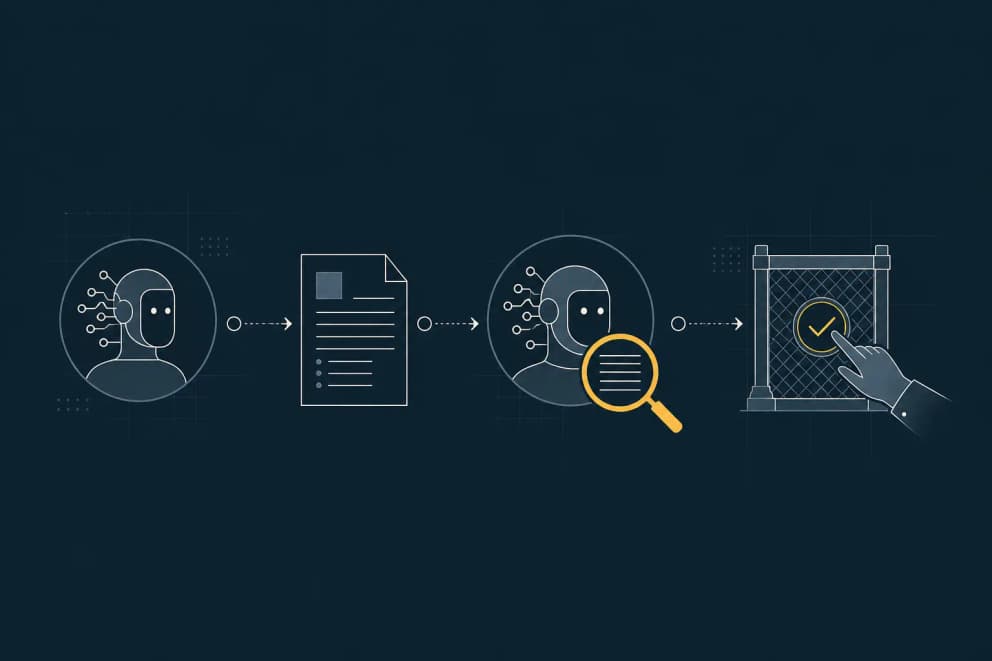
Businesses have long had an answer to this problem: the four-eyes principle. The person reviewing an invoice should not be the person who prepared it. We apply the same principle to AI work by assigning a second AI agent that had no part in producing the result and ideally runs on a different model, so the same blind spot does not pass twice. We will simply call it the reviewer.
What is new about the principle is only its reach. Between people, the second pair of eyes stays scarce: independently recomputing every figure in a report was always possible and, because of the cost, almost never done. A reviewing agent makes that thoroughness affordable, as attentive on the two-hundredth figure as on the first.
Fixed rules first, judgment second
The reviewer is the second of two control stages, and the distinction matters. The first stage consists of mechanical checks. These are fixed rules that a program applies without judgment, such as whether every required field is filled, whether a draft stays within its length limit and whether each claim has a source. Such checks cost almost nothing and run the same way every time; once they catch a defect, they will keep catching it.
The sentence from 25 August would have passed every one of those checks. It sat in the right document, was complete and read cleanly, but contradicted the decision. No fixed rule can decide whether a sentence does that or whether a source truly supports a claim. Those questions require judgment, and that is where the reviewer starts. The order is deliberate: mechanical checks remove the straightforward defects before the reviewer receives work that contains only the questions requiring judgment.
How the reviewer works
The reviewer knows nothing about how the work was produced. It sees exactly two things: the decision as the owner stated it and the finished documents as they actually read. This blindness is central to the method because it makes the reviewer read the text as an outsider later would, without knowing what its author meant.
Three rules turn the second look into a dependable review:
- No finding without evidence: For every finding, the reviewer must quote the exact sentence it challenges; “this feels unclear” does not count. The rule appears verbatim in our internal review instructions, and the case from 25 August shows its value: all 13 findings returned with the challenged sentence quoted. That made correction a direct edit instead of a search.
- Every review point receives a verdict: The reviewer works through a fixed list and records a result for every item, including “clean”. Silence can therefore never hide that a point was not reviewed.
- The reviewer changes nothing: It finds defects, and the author corrects them afterwards. Letting the reviewer intervene immediately would be faster, but we keep the two roles apart on purpose. A reviewer that corrects the work becomes a second author and would then need its own reviewer.
In the case from 25 August, the reviewer returned 13 evidence-backed findings. 2 were serious: the sentence described at the start, which would have defeated the new rule, and a note that still declared the old version authoritative. The other 11 were smaller, including a condition missing from one passage. The author corrected every finding, after which the mechanical checks ran again. Only then was the result accepted.
Who reviews the reviewer?
A review checklist can be wrong in two directions: too lenient or too strict. We therefore test the reviewer before it sees real work, using two prepared cases. The first is a known-good piece of work; a capable reviewer lets it pass with no more than minor comments. The second is an intentionally defective piece with hidden, pre-documented errors (the answer key is kept in a separate document that the reviewer may open only after giving its verdict; once it knows the error list in advance, it is checking boxes rather than reviewing). If the reviewer misses even one hidden error, we tighten the checklist and run the test again.
This sounds laborious, but it follows the same logic as a fire drill: test the protection before there is a fire.
The person remains the final gate
For everything this method provides, it explicitly does not replace human sign-off. Nothing leaves our business after review by AI alone: no message is sent and no change goes live until a person approves it. The second agent serves a different purpose. The person receives work whose craft defects have already been found. The agent adds its reasoning and sources, names the points a person still has to check and says how. The person can then concentrate on the business decision.
This article deliberately does not decide how much assurance every task deserves. An email to a long-standing customer may need less than a rule that will govern quotations for years. We have set out how to match review effort to risk for that decision.
How to recognize a dependable review process
When a provider or your own team completes AI work for you, five questions reveal how seriously they approach quality assurance:
- Does the same AI review its own work, or does a second, uninvolved agent review it?
- Must the review supply evidence, such as a quotation or source for every finding?
- Has the review process itself been tested, for example with a case whose errors were known in advance?
- What happens to findings: what stops the work immediately, what is corrected later and what do you decide? It helps to define how you will recognize a correct result beforehand.
- Where do you sign off, and can the AI bypass that point?
If the answer to the first question is “the AI reviews itself”, you have heard enough.
In our experience, the most dangerous AI-work error is a plausible sentence that quietly defeats a business rule. Whether it is also the most common depends on the task and remains an open question. What we do know is that the remedy lies mainly in the process, not in the next model. Where that review step belongs when an agent is built is covered in Building AI Agents: No-Code Platform or Code?.