
AI and the Labor Market: What Anthropic Measured in Its Own Workforce
On 16 October 2026, Anthropic, the company behind Claude, published a report on its own workforce. Its four authors analyzed personnel records, AI agent usage logs, code statistics, calendars, Slack channels and interview scorecards, and they conducted 17 interviews with employees. The result is a rare look inside a company where AI agents now work more hours than the people who direct them.
Anthropic is no benchmark for a company with 40 employees. It tripled in size within a year, it sells the tool it uses, and the authors themselves say that many of its employment practices cannot be replicated across the economy. For the question of how AI changes the labor market, the report is an early signal rather than an average. It shows which work shifts when a company adopts AI agents early and widely. Other studies show how far that shift has already reached in the United States and in Germany.
What Anthropic measured
In March 2026, the hours worked by AI agents at Anthropic exceeded the hours worked by its employees for the first time. That count includes agents running on their own and agents an employee steers in an interactive session. In the steered sessions alone, agents worked six hours in August for every hour of the person directing them. Code commits per engineer reached five times their level of six months earlier. In sales, representatives close deals with more clients after adopting agents. The authors note that the representatives with the most sales opportunities may simply have adopted first.
In this data, the additional code did not get worse. The authors compared code written by agents with code from the same person in the same month and found no difference in how often it was later deleted or reverted. They point out that the 192 engineers who adopted agents chose when to switch, so the comparison with 74 engineers who did not adopt is not a controlled experiment.
More code also does not mean proportionally more finished software. An NBER study by Demirer, Musolff and Yang measures 240% more coding activity for autonomous coding agents, but only 80% more projects and 30% more releases. Their estimate suggests that AI and human effort barely substitute for each other. The human share of every result remains the weak link that sets the pace.
Attention is the bottleneck
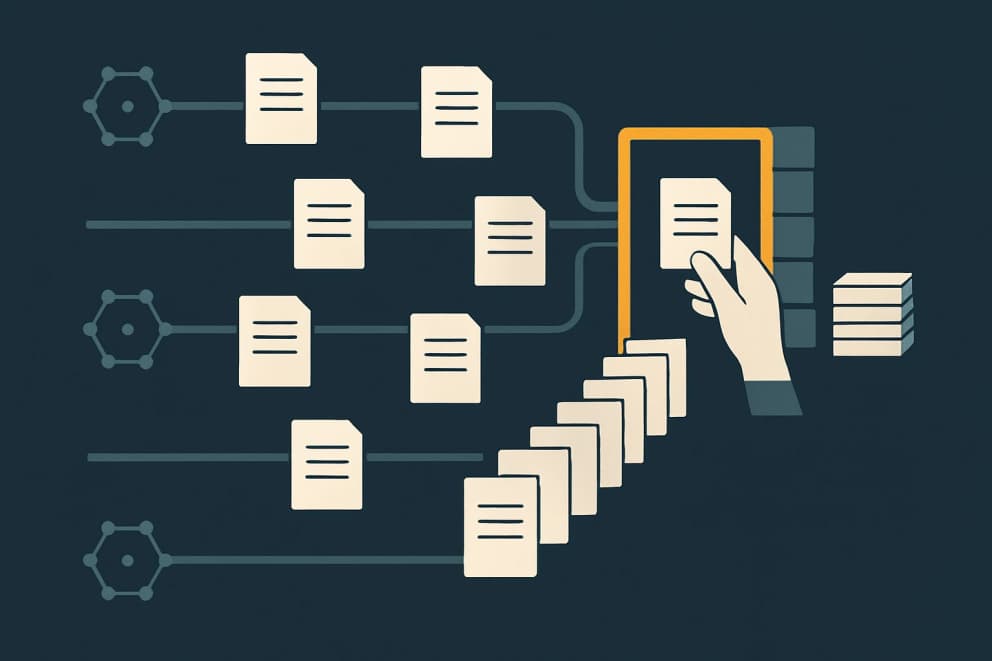
The clearest finding in the report concerns the people. Around 80% of the time in an interactive Claude session is spent waiting for human input. Even in non-technical departments, reading everything the agents write for one employee would take more than half a working week. One interviewee describes "an army of Claudes, with every one asking for my attention". The median employee spends 20% more time in meetings than a year earlier.
For a small company, this is the most important lesson. Once AI agents deliver faster than anyone can check, the checking determines the value. We have described this review bottleneck for AI-generated code. Anthropic's numbers now show it in departments that write no code.
Nobody can read everything. A delegation map therefore sets, for each step of a workflow, where a person approves, where a sample is enough and where a fixed check takes the load off people. Without that decision, either nobody checks or everyone checks everything.
New work: writing instructions and directing agents
A new kind of work is growing at Anthropic. The share of sessions in which employees build tools, supervise agents or document processes rose from 10% in fall 2025 to 22% in spring 2026. The authors call this meta-work. The number of standing instructions for agents grew from a few hundred in July 2025 to about 8,500 a year later. One in five employees who gave a free-text answer in the April 2026 survey describes a shift from doing the work to managing the agents.
Those 8,500 instructions are what we call context management: company knowledge in a form that both people and AI agents can work with. It grows one task at a time, whenever someone records after a successful run how the task should go next time. Our example with three supplier invoices shows how a single assignment becomes such an instruction. Budget for this time when you judge what an agent is worth. At Anthropic, a growing share of interactive Claude sessions concerned this kind of meta-work.
Fewer entry-level jobs
Junior workers make up a shrinking share of Anthropic's technical staff and hires. In technical departments, the junior share of employment fell from 21% to 14% since early 2025, and the junior share of technical hires fell from 27% to 9%. Technical departments kept growing, but more slowly than sales, finance and recruiting, so their share of headcount fell from 61% to 56% within a year. In interviewers' scorecards, comments on autonomy and judgment increased the most, while domain expertise lost weight.
Anthropic is not an isolated case. Brynjolfsson, Chandar and Chen at the Stanford Digital Economy Lab find in US payroll data through June 2026 that employment of 22- to 25-year-olds in highly AI-exposed occupations is about 19% below where it would be had it kept pace with less exposed occupations. Hosseini Maasoum and Lichtinger at Harvard University analyze résumés and job postings covering 65 million workers. After generative AI became widely available in early 2023, junior employment at adopting firms fell by about 9% relative to comparable firms within six quarters. For senior workers, the authors found no matching break in the employment trend. Both studies attribute the decline mainly to slower hiring.
Will AI cause mass unemployment?
For Germany, the answer so far is no, with a caveat for young workers. On 13 October 2026, the IAB, the research institute of Germany's Federal Employment Agency, analyzed agency data on about 22.3 million full-time employees. Among 20- to 29-year-olds, full-time employment since 2022 fell by 3.8% in highly AI-exposed occupations and by 2.6% in less exposed ones. The gap is not yet statistically significant, but it is growing. According to the IAB, the decline is associated more than twice as strongly with the weak economy as with AI.
The Kiel Institute finds no measurable effect on overall employment in data from Denmark, Portugal and Sweden between 2010 and 2023, but rising demand for higher qualifications. Its data ends before the arrival of AI agents. IAB researcher Enzo Weber summed up the situation for Tagesschau: there are no large waves of layoffs, he said, but very few new jobs are being created.
Inside companies, the change has only just begun. According to Bitkom, the German digital industry association, 57% of German companies with at least 20 employees use AI in 2026, the first time a majority does. Among companies that use, plan or discuss AI, however, only 11% already use AI agents. Anthropic is describing a state that most German companies have not reached yet.
What a small company can take from this
Anthropic closes with recommendations for employers. Broad employee ownership is easy for a firm whose valuation has risen sharply, as the authors admit. Two other proposals carry over to a company with 20 or 200 employees.
The first is an internal early-warning system that tracks, role by role, how much work AI takes over. A small company needs no metrics software for this. A list of tasks per role is enough, showing which tasks an AI agent already completes, which it prepares and which stay with a person. Update the list every quarter and you see early where time is being freed.
The second concerns what that time is used for. The authors advise moving people to new work inside the company before roles disappear. At Anthropic, employees with at least one year of tenure were 50% more likely to change departments in 2026 than in 2025. The authors draw on a warning by Acemoglu and Restrepo: the threat to employment comes less from brilliant technology than from so-so automation that replaces people while barely doing better, such as poor automated customer service. For most companies, the obvious use for freed time is the work that has been waiting: following up on quotes, planning campaigns, preparing analyses.
The recommendations explicitly do not solve the problem of entry-level hiring. Protections for current staff do not help anyone who is never hired, the authors write. For a company that trains apprentices and graduates, this is a practical question. If an AI agent takes over the research, drafts and data upkeep that newcomers used to learn from, they need a different way to learn. We recommend letting newcomers review agent results and co-write agent instructions early, alongside an experienced colleague. That practices the qualities that gained weight in Anthropic's hiring interviews: autonomy and judgment. Whether this route builds as much domain knowledge as the manual work did is an open question. We do not have evidence for it yet.
In the AI enablement workshop of our setup stage, your team spends two days handing whole tasks to Claude, ChatGPT or Copilot, reviewing the results and recording which instruction will help next time: Discuss an AI enablement workshop.