
Deploy AI agents that take over whole tasks
Gain time for customers and new projects by handing over whole tasks. Agents research, create reports, prepare marketing and implement software changes. We set them up with your team. You define goals and boundaries, review results and direct the work through a shared overview.
Use AI agentsYou set the goal. The agent carries out the steps.
If you ask AI for sales ideas, you receive suggestions. An agent can take on the work that follows: research companies, explain their fit against your requirements and prepare outreach drafts. It needs company knowledge, access to the right tools and a clear assignment. Your sales team reviews the selection and decides whom to approach.
Your entire company knowledge does not fit into a single request, because an AI model can only process a limited amount of text at once. The agent therefore has to find what it needs for a task on its own. To make that possible, we store documents in a clear, readable structure, give the agent search access to your programs and write down in its instructions where each piece of information lives. An agent that finds the right price list writes a better quotation than a stronger model that never gets to see it.
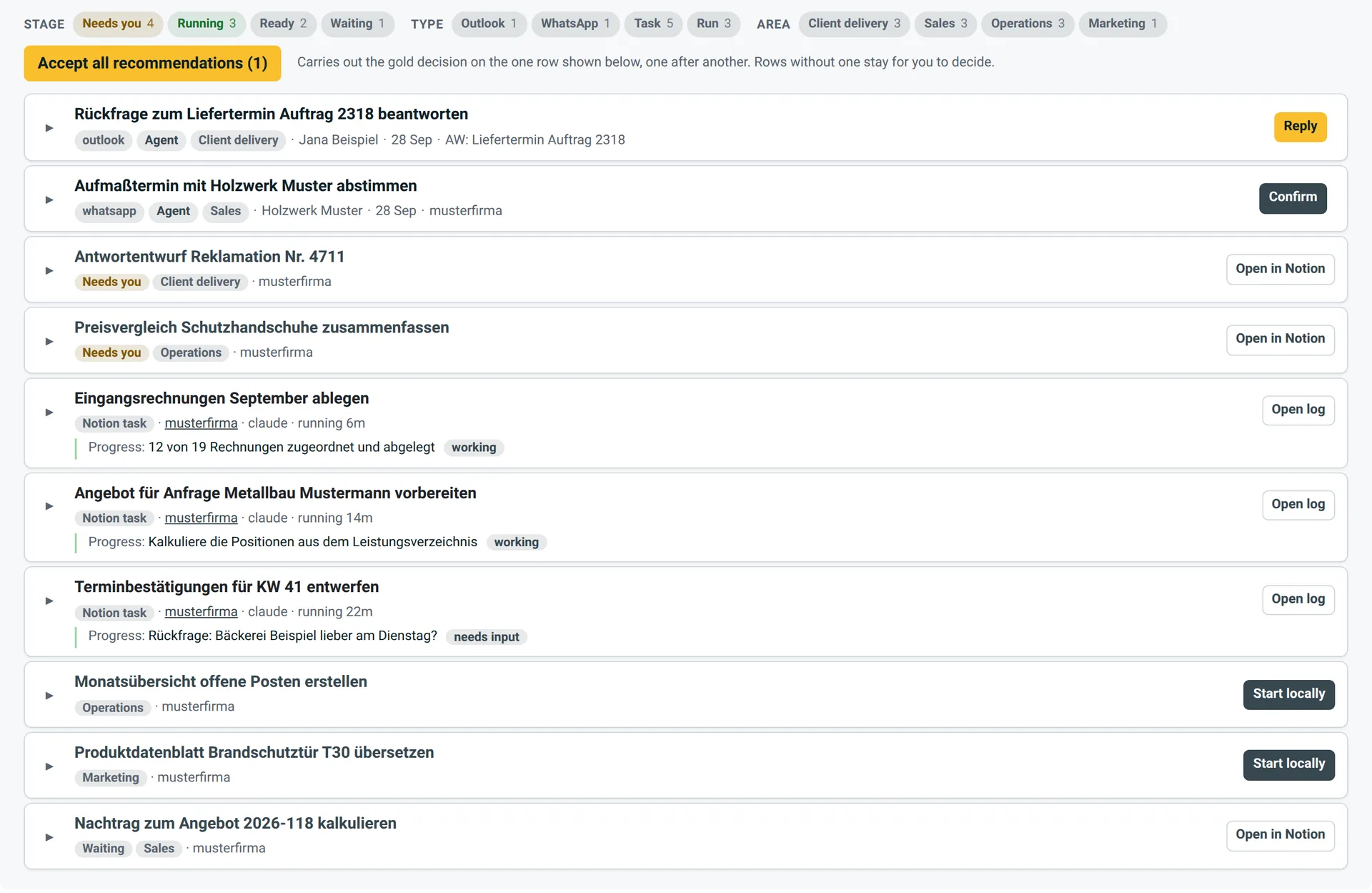
The same applies to other tasks: a report needs data and sources, a marketing draft needs an audience and product knowledge, and a software change needs requirements and tests. Agents can work on such tasks in parallel. The shared overview shows progress, completed results and open questions. You can give further direction or stop the work.
Your team's work shifts towards keeping agent knowledge and instructions current, assessing results and making decisions about risk. We establish this way of working together. For each task, we agree what data the agent may read and what it may change. Small, reversible steps can run with spot checks. Binding commitments and publication need human approval. To keep that review short, the agent delivers its reasoning and sources with every result and says what your team should look at and how to verify it. Formal checks and a first review of the content can be done by a second agent before a person sees the result, ideally running on a different AI model so the same mistake does not slip through twice. That is how we review our own work, too.
What an agent deployment covers
An agent deployment covers the Setup stage and, where needed, the Development stage, followed by the ongoing Optimization stage. Before that come a free intro call and usually the Assessment as the paid entry. We use existing tools where they are enough.
Assessment
You show us how your team works and what it wants to achieve. In one day, we define together which tasks agents can take on and who assesses the results. Real examples help us understand requirements and exceptions. We use these to recommend the right scope.
Setup
We connect the tools your team already works with: file storage, project and task management, email and documentation. The agents get exactly the access they need there and find company knowledge and work instructions in the right place. Together, we consider what could happen if something goes wrong, and we limit access. That determines the checks, required approvals and how to undo a change. We use real examples to check whether the agent produces useful results. Through a shared overview, your team assigns work, follows progress and reviews results. Your team then practises handing whole tasks to the connected agents on cases from its own week. Nothing is built in this stage.
Development
We build what does not exist yet: custom software for connections and workflows that go beyond the ready connectors of the setup. This pays off when the rules and exceptions of your workflow are too precise for a written instruction, a program has no ready connector, or the work should run without anyone starting it. What already works reliably can be reused for further tasks. You own the code.
Optimization
After launch, we review every month how the agents work. If they run in software we built, we see for every run which documents and instructions it used, what it cost and whether your team accepted the result. Corrections go back into the source, and we test changes on the same real examples. We help your team keep track of whether the right information is available and discoverable for the agents, for example when a file store moves or a work instruction goes out of date. For software we built, ongoing operation is included. We agree this program separately.
Not every task needs an agent
We choose the smallest dependable approach. Where an agent is the wrong one, we say so in the intro call and not after the invoice.
The rule fits in three sentences
If the rule for the normal case fits in three sentences, a fixed automation is faster and cheaper. It returns the same result for the same input every time, which makes it easier to verify. With AI, we now build such automations with far less effort than before. Even inside an agent's task, the agent calls a fixed automation for every step that follows a rule, such as a calculation or a comparison.
An existing tool is enough
Claude, ChatGPT, or an application you already use solves the task as soon as it gets the right context. In that case we set up that working method, for example in the enablement workshop, instead of building something new.
The necessary information is not available yet
An agent works with what it can read. When the decisive details sit in people's heads, in email threads, or on paper, the first step is to make them available, not to put an agent on top of them.
How we carry out projects ourselves
We carry out many of our projects through our own agent hub or its earlier versions. The hub brings tasks together and starts agents that do the work. We follow progress, give instructions and review results. We approve software changes for release after the checks. At MAFU-SHERPA an AI sales assistant scores potential customers by their machine park, lot sizes and processes and drafts outreach. The salesperson reviews and sends. The DATEV export at the same client follows fixed rules and therefore runs as a fixed automation.
“Frighteningly good, in quality and in speed.”
You talk directly to the developer who is responsible for your solution. You do not need a requirements document for that. One real example from your business is enough to begin.
Book an intro callFAQ about AI agents
Is an existing AI tool enough, or do I need a custom agent?
An existing tool may be enough if it can complete the task with the right data and permissions. A custom agent makes sense when your shared workflow needs connections or rules that cannot be set up reliably in that tool. What matters is how the task is carried out and how the result is checked. The product name alone tells you little about that.
When does an AI agent pay off, and when not?
An agent pays off when the rule cannot be written down in advance, because every case looks different: reading requests, reconciling data, preparing drafts. If you can write the rule for the normal case in three sentences, a fixed automation is cheaper and easier to verify, and we will tell you so.
Does an AI agent need its own software?
Often yes, but never for its own sake. An agent needs access to the right data, connections to your programs and a point where a person checks the result. We build that environment alongside the agent: from single interfaces up to custom software when your workflow has rules of its own.
Talk to us about your workflow
We like to start with the back-office work that slows your business down, which of those tasks an AI agent can take over, and which software it needs for that.
Give us a call:
+49 30 3505 6713Or write to us:
hello@certaince.comChat with us on WhatsApp:
https://wa.me/493035056713